📖 Background
Why krsim
krsim models the transmission of malaria parasites between human hosts through mosquito vectors. It builds on the Wright–Fisher model, a foundational model of population genetics, and adds a few key epidemiological factors: superinfection, the number of parasites passed on in each bite, and the number of oocysts in each mosquito.
This approach was first taken by Kwiatkowski (2024), following a single genetic locus. krsim extends it to the whole genome: using tskit, it records every recombination event, so the full ancestry of every parasite genome is kept, and it stays very fast to run.
krsim can be used to:
- simulate transmission under known parameter values
- understand relatedness between parasite strains, within and between hosts
- benchmark whole-genome tools, such as relatedness and IBD methods, against a known truth
It is designed as a foundational model, with many possible avenues for extension.
The transmission model
krsim follows a population of Nh human hosts through T discrete, non-overlapping generations. Each host carries one or more parasite strains, and in every generation each host is infected afresh by parasites drawn from the hosts of the previous generation, passed on by a mosquito.
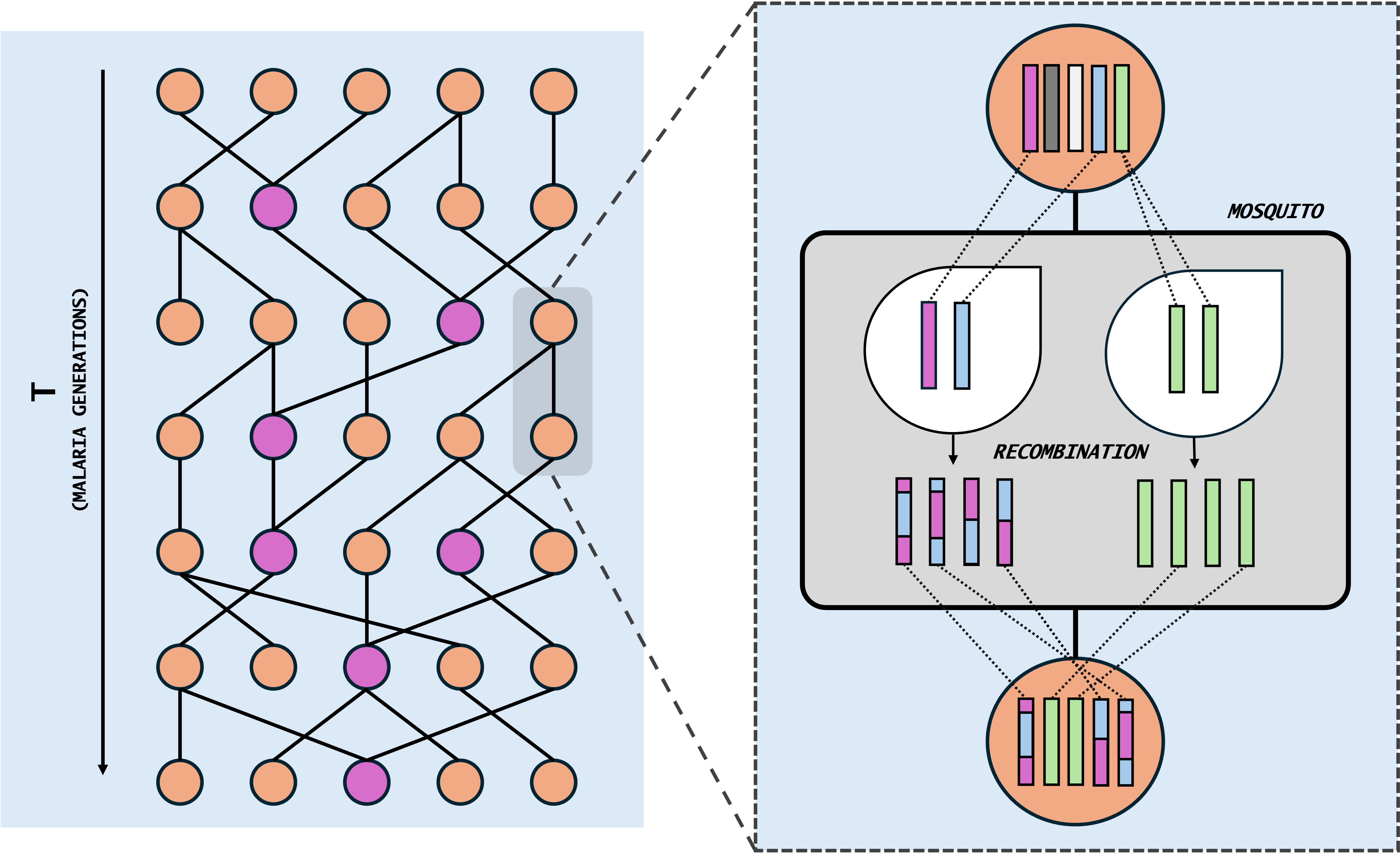
Founders. The simulation starts T generations before the present. Each founder host carries K strains, or 2K if it is superinfected, which happens with probability chi.
Each generation, every host in the new generation is infected in one of two ways:
- Single infection (probability
1 − chi): one parent host is chosen at random, and one mosquito carriesKparasites from it. - Superinfection (probability
chi): two different parent hosts are chosen, and each passes onKparasites through its own mosquito, giving the host2Kstrains.
Inside the mosquito, each of its C oocysts is formed from two parasites drawn from the parent host (with replacement, so the same strain can pair with itself). Meiosis in each oocyst produces four recombinant products, and the K parasites passed on are drawn from all 4C products.
| Parameter | Flag | Meaning |
|---|---|---|
| \(N_h\) | --Nh |
Number of human hosts |
| \(T\) | --T |
Number of generations simulated |
| \(K\) | --K |
Parasites passed on per mosquito bite |
| \(\chi\) | --chi |
Probability that a host is superinfected |
| \(C\) | --C |
Oocysts per mosquito |
The model set-up and the choice of these epidemiological parameters follow Kwiatkowski (2024), where they add just enough malaria transmission dynamics to a Wright–Fisher population. krsim extends this with mosquito dynamics: oocysts, meiosis, and the sampling of the parasites passed on.
Suitable parameter values vary between transmission settings, so choose them to match the setting you want to simulate.
Recombination
Recombination happens in the mosquito, between the two parasites that form each oocyst. The genome is the P. falciparum 3D7 reference: 14 chromosomes, 23.29 Mb in total (PlasmoDB-54, the reference used by MalariaGEN Pf8). Each recombination event between two parental genomes combines two kinds of breakpoint:
- Independent assortment: at each chromosome boundary, the products switch parent with probability 0.5.
- Crossovers: a Poisson number of breakpoints with mean
recombination_rate × genome length, placed uniformly along the genome. The default rate is7.4e-7per base pair, following Kwiatkowski (2024).
Two such events per oocyst give its four products.
Recording ancestry
Every parasite genome is recorded as a node in a tskit tree sequence, and every stretch of genome inherited from a parent is recorded as an edge. Together these form an ancestral recombination graph: for any position on the genome, it gives the full genealogy of the current strains.
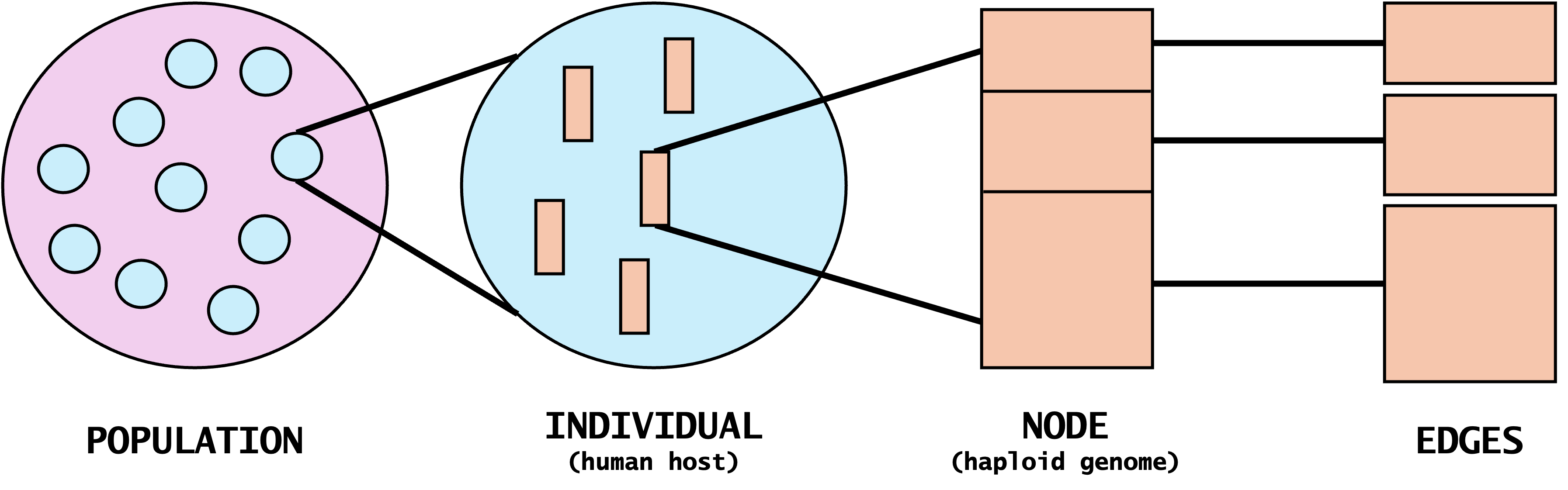
At the end of the run the tree sequence is simplified to the strains in the current generation, keeping only the ancestry they actually inherited. This is what ts_{seed}.trees contains. The --save_lineage option keeps the full generation-by-generation pedigree as well, which the pedigree maps use.
From genealogy to data
- Mutations are added on top of the genealogy with msprime, at rate
--mutation_rate(default1e-6per base pair, following Kwiatkowski (2024)). - Coalescence times are read directly from the genealogy: for every pair of strains and every stretch of genome, when their ancestry last met.
- Strain VCF: one haploid genotype per strain, as if each strain were sequenced on its own.
- Host VCF: mimics sequencing a mixed infection from a blood sample. Each host gets realistic read depth along the genome, either from real samples’ depth files or from a model fitted to MalariaGEN Pf8 sWGA or gDNA samples (see realistic read depth). Each host’s strain proportions are drawn from a Dirichlet distribution, the reads at each site are shared between its strains, and a site is called
0/1when the reads carry both alleles.
The VCFs have the same form as real sequencing data, while krsim also knows the true ancestry behind them. This makes them a way to benchmark whole-genome methods against a known truth: for example, comparing the IBD that hmmIBD infers from the strain VCF with the true relatedness from krsim relate-strain.
References
- Kwiatkowski D. (2024). Modelling transmission dynamics and genomic diversity in a recombining parasite population. Wellcome Open Research 9:215. https://doi.org/10.12688/wellcomeopenres.19092.1
Citing krsim
A paper describing krsim is in preparation. Until then, please cite the GitHub repository.