ODM is an open-source modelling stack for infectious disease research. odin specifies models in a clear declarative language, dust runs them as fast stochastic simulations, and monty fits them to data through Bayesian inference — one open workflow from idea to evidence.
📦 Packages and workflow
Together, these components form a modular modelling–inference pipeline used across UK infectious disease research.
Composable
Use components independently or combine into a full modelling pipeline.
Efficient
Compiled models and scalable simulation enable fast, large-scale workflows.
Robust
Modern inference supports principled uncertainty quantification.
🌱 Our vision for ODM
What we're trying to do
Make the work of building, running and fitting epidemiological models transparent, reproducible, and within reach — for research groups, outbreak responders, and students.
How we want to get there
- As a community. Widening the circle of contributors, institutions and users who shape the stack.
- Distributed stewardship. Maintainership shared across institutions and career stages, with a public roadmap.
- Accessible. Lower barriers to contribute and to use, with documentation, contributor guides and transparent governance.
Why it matters
Robust, accessible tools — ready for use now, and for the next emergency. Transparent and well-maintained, sustained by a community that knows how they work and trusted by the researchers and responders who depend on them.
⚕️ Example: public health workflow
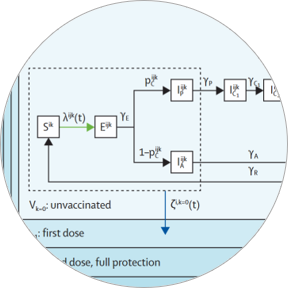
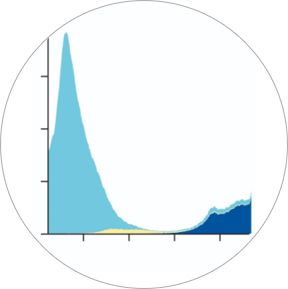
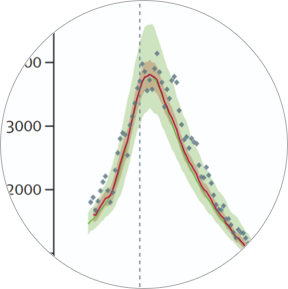
This supports decision-focused outputs such as projected impact of interventions, uncertainty bounds, and comparison of policy options.
Figures from Imai et al. (2023).
🔬 Use in research and policy
The stack is used across academic research, public health analysis, and teaching. Examples include:
- Infectious disease modelling studies published in leading journals
- Analyses supporting the UK COVID-19 response and government decision-making
- Collaborations with public health partners, including the UK Health Security Agency
- Teaching at BSc and MSc level and international short courses in infectious disease modelling
The tools are used across multiple UK institutions and internationally, with active community contributions through open development on GitHub.
📄 Related publications
-
FitzJohn et al. (2021).
Reproducible parallel inference and simulation of stochastic state space models using odin, dust, and mcstate
Describes the design and application of the odin–dust modelling and inference framework for infectious disease modelling. -
Knock et al. (2021).
Estimating the effects of non-pharmaceutical interventions on COVID-19 in Europe
Estimates the impact of the 2020 lockdown, shows insufficient population immunity to avoid a subsequent wave without continued NPIs or vaccination, and estimates age-specific severity profiles. -
Perez-Guzman et al. (2023).
Estimating the intrinsic and effective transmissibility and severity of each SARS-CoV-2 variant
Disentangles variant-specific transmissibility and severity from confounding factors including NPIs, vaccination, and age heterogeneity for each variant that circulated in the UK. -
Sonabend et al. (2021).
Key epidemiological drivers and impact of interventions in the 2020–2021 SARS-CoV-2 epidemic in England
Demonstrated that NPIs needed to be lifted gradually in parallel with vaccination to mitigate epidemic rebound risk, supporting the UK roadmap out of lockdown. Also quantified the impact of the Delta variant and the need to delay the final lockdown step. -
Imai et al. (2023).
Modelling the impact of delaying vaccination against SARS-CoV-2 in the UK
Estimated the impact of the UK's decision to delay second vaccine doses so that more people could rapidly receive their first dose. -
Perez-Guzman et al. (2024).
Reconstructing the COVID-19 epidemic in Zambia
Adapted the real-time modelling approach to analyse the pandemic in Zambia using sparse data. Showed the epidemic was far larger than reported — challenging the narrative that COVID-19 spared Africa — and estimated that earlier vaccine availability at higher daily capacity could have averted a substantial fraction of deaths. -
van Elsland et al. (2024).
Global policy impact of Imperial College London COVID-19 research
UK and global policy impact of covid modelling built using the software stack.
📚 Resources
Documentation and tutorials
For additional information, examples, and tutorials, please see:
- odin: https://github.com/mrc-ide/odin2
- dust: https://github.com/mrc-ide/dust2
- monty: https://mrc-ide.github.io/monty/
- odin & monty book: https://github.com/mrc-ide/odin-monty
- Workshop (2025): https://mrc-ide.github.io/odin-monty-workshop-2025/
Team and institutional context
- Research Software Engineering team: https://reside-ic.github.io/about/
- Department: https://www.imperial.ac.uk/mrc-global-infectious-disease-analysis/